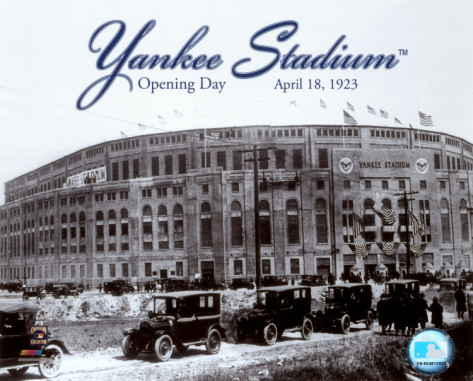
 The story of opening day at Yankee Stadium all started on February 6, 1921 when news circulated that the Yankees purchased ten acres of land in the Bronx, just across from the Harlem River, from William Waldorf Astor. The purchase price of the land was $675,000. That land was where history was going to be made. What a bargain, right? Previously, the Yankees shared the Polo Grounds with the National League Giants. Once attendance started to soar for the Yankees due to stand-out performances from the players, the Giants basically told the Yankees to pack up and vacate the premises. Once co-owners of the Yankees Jacob Ruppert and Tillinghast l'Hommedieu Huston purchased the property, the plans were in place to build a three-story structure that be the first to ever be called a 'stadium.'
Construction on Yankee Stadium amounted to $2.5 million and amazingly only took 284 days to build. The American Flag and Yankees pennant were hoisted by center field by the Seventh Regiment Band, John Phillip Sousa, and both the Yankees and Red Sox.
.jpg) On April 18, 1923 with a crowd of just over 74,000 fans, Yankee Stadium opened its doors to the world to watch the Yankees take on the Boston Red Sox. As history was made, fans crowded themselves outside the gates of the stadium. Babe Ruth, one of the greatest players in the history of the game, scored a three-run home run to lead the Yankees to their first win at Yankee Stadium. What a way to finish off a historical day in the Bronx!
On April 18, 1923 with a crowd of just over 74,000 fans, Yankee Stadium opened its doors to the world to watch the Yankees take on the Boston Red Sox. As history was made, fans crowded themselves outside the gates of the stadium. Babe Ruth, one of the greatest players in the history of the game, scored a three-run home run to lead the Yankees to their first win at Yankee Stadium. What a way to finish off a historical day in the Bronx! 
Other Yankee Stadium facts:
- Yankee Stadium became "The Home of Champions" due to the amount of World Series they won.
- The Yankees won their first World Series against the Giants (remember the Giants kicked them out of the Polo Grounds?)
- The stadium was expanded in 1928.
- It completed a $1.5 million renovation in 1966 to 1967.
- The Yankees moved to Shea Stadium for three season after a 1973 decision to renovate the ballpark once again.
- On September 21, 2008 the Yankees finished off an incredible end to what was the original Yankee Stadium, before it was to be torn down.
- Catcher Jose Molina scored the last home run; Andy Pettitte was the winning pitcher, while Mariano Rivera threw the last pitch to close the game.
- The all-time Yankee attendance was recorded at 151,959,005.


